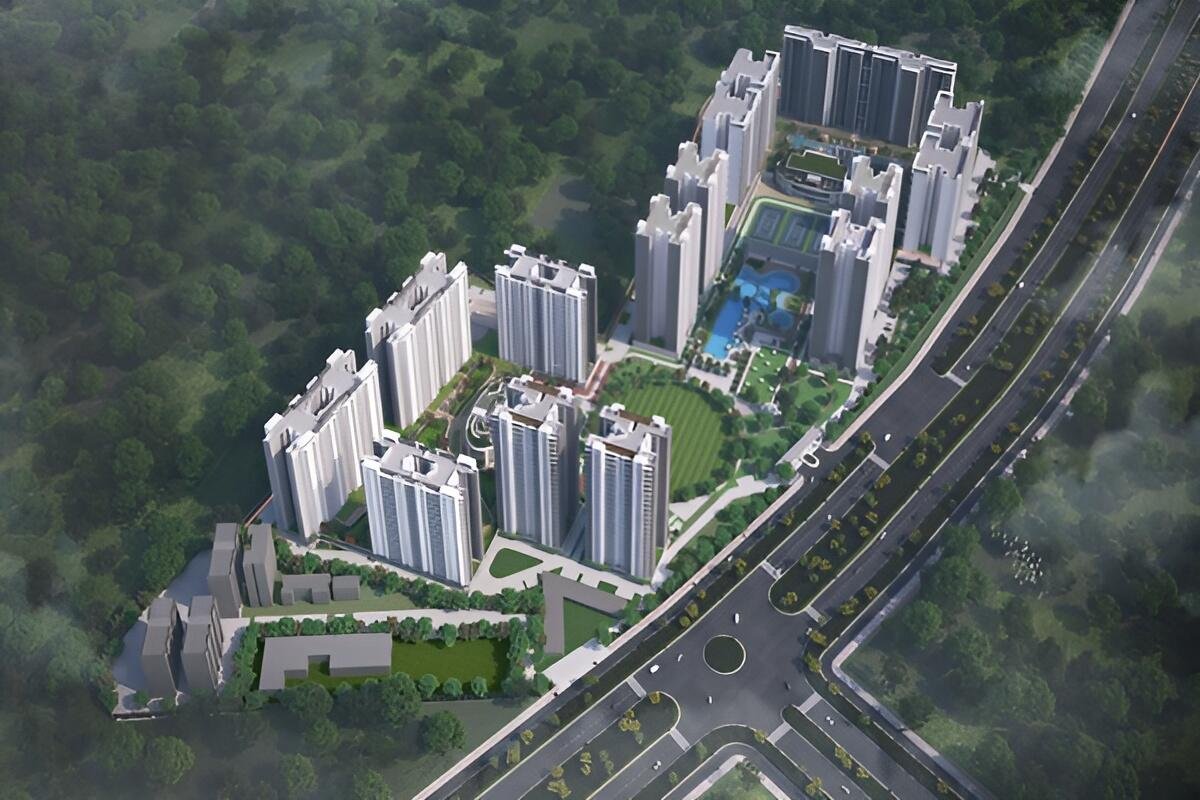
A road that stopped being a promise
For most of its life, Dwarka Expressway was a cautionary tale. Land was bought in 2006 on the strength of a corridor called the Northern Peripheral Road, and then almost nothing happened for a decade. Litigation, land acquisition, a half-built spine, and a generation of buyers who learned to say the words "under construction" with a sigh.
That chapter closed. The Haryana stretch opened to traffic in March 2024. The Delhi stretch, a roughly ₹5,360-crore build, followed and took the full 29-kilometre, largely elevated, eight-lane access-controlled highway live end-to-end. NHAI bills it as the longest elevated urban road of its kind, with an eight-lane main carriageway sitting above eight lanes of service road.
The price response was not subtle. Between Q4 2024 and Q1 2025, housing prices along the expressway recorded a 58% year-on-year jump, the sharpest of any residential corridor in India during that window, as recorded in the CREDAI-Colliers-Liases Foras report. Anyone who bought before the road opened is sitting on a number they did not have to work for.
Which raises the only question that matters now: if the easy money has already been made, is there a reason to buy here in August 2026?

"I get asked whether Dwarka Expressway is 'too late' about four times a week. My honest answer is that the connectivity re-rating is done — you missed that. What has not been priced in yet is the employment re-rating. Right now this corridor is still overwhelmingly a place people sleep and commute out of. Global City, the metro spur and the commercial pipeline are what turn it into a place people also work in. That is the second leg, and it plays out over the next five to seven years, not the next five months."
What the price record actually shows
Start with the performance data rather than the pitch. According to 99acres, flat rates on Dwarka Expressway have moved roughly 12% over the last year, 75% over three years and 152.3% over five years, with ten-year appreciation figures reported in the 180–200% range depending on the source and the base date used.
Reconstructing that as a price path is instructive, because it shows the growth was not smooth. It was flat for years, then violent.
Average apartment rate, Dwarka Expressway
Rupees per sq ft — reconstructed from reported appreciation data
Indicative path derived by back-calculating from 99acres and Magicbricks appreciation percentages against the 2026 average of about ₹14,000 per sq ft. Individual sectors and projects vary widely — Sector 106 and Sector 108 luxury inventory trades materially above this line. Verify current rates before transacting.
Notice the shape. From 2016 to 2021 the corridor essentially did nothing. Every rupee of the headline five-year return was earned in the last thirty-six months, and it was earned by infrastructure delivery, not by marketing. That is the single most useful thing this chart tells you: on this corridor, price follows completed infrastructure with a lag.
Where rates sit today
| Asset type | Rate band (per sq ft) | Read |
|---|---|---|
| Apartments | ₹11,000 – ₹16,750 | Average near ₹14,000; luxury sectors sit at the top |
| Builder floors | ₹9,000 – ₹13,900 | Thin resale market, slower exit |
| Plots / land | ₹17,250 – ₹26,800 | Average near ₹22,200; scarce and tightly held |
| Gross rental yield | ~2% | Typical for Indian residential; returns are capital-led |
The comparison that decides most purchases
Dwarka Expressway is not the most expensive address in Gurugram, and that gap is the entire investment thesis for a lot of buyers.
| Micro-market | Indicative residential rate | Maturity |
|---|---|---|
| DLF Phase 1–5 | ₹25,000 – ₹45,000+ | Fully mature, low growth headroom |
| Golf Course Road | ₹14,000 – ₹35,000 | Mature, premium-priced |
| Dwarka Expressway | ₹11,000 – ₹16,750 | Infrastructure complete, build-out ongoing |
| Sohna | ₹7,500 – ₹8,500 | Early stage, higher execution risk |
"Read that table as a ceiling question, not a cheapness question. Golf Course Road is a finished product — you are buying a stabilised asset with a stabilised price. Dwarka Expressway still has an unbuilt half. Estimates put the corridor at roughly 60% built out, which means the comparable set five years from now is a completely different neighbourhood from the one you drive through today."
"The mistake I see people make is treating the price gap as a discount. It is not a discount. It is compensation for the fact that you are still carrying construction and absorption risk. Whether that trade is worth it depends entirely on your holding period, and I will tell a client to stay out if their horizon is under four years."
Fewer launches, steady buyers — and what that does to pricing
The most important recent datapoint is not about Dwarka Expressway specifically. It is about supply. ANAROCK's Q2 2026 numbers show NCR launches at 11,205 units, down about 40% year-on-year, against sales of 13,365 units, down only about 6%. Unsold stock across NCR stood near 89,086 units. Developers pulled back hard on new supply while buyers largely kept buying.
Gurugram led the region on both launches and sales, with its own launches down about 8% and sales down about 4% — a far shallower correction than Noida and Greater Noida, where supply collapsed by roughly 72%.
The price consequence showed up immediately. NCR recorded a 13% year-on-year price rise in Q2 2026, the steepest among India's top seven cities, and ANAROCK attributed it largely to Gurugram's premium corridors — Dwarka Expressway, the Southern Peripheral Road and Golf Course Extension Road. Quarter-on-quarter growth was a more modest 2%, which is the sanity check worth remembering.
- NCR inventory overhang improved to about 18 months in Q1 2026, down from 19 — absorption is holding up.
- Gurugram's average residential rate rose from roughly ₹6,150 per sq ft in Q1 2020 to about ₹11,300 by Q1 2025, close to 84% appreciation citywide.
- Demand has shifted decisively toward premium and luxury formats; sales value is rising faster than unit volumes.
Read this carefully
A launch slowdown paired with steady sales tightens buyer choice over time. It does not mechanically guarantee price appreciation in any individual project. One quarter of data is a signal about negotiating room, not a prediction. Check the specific tower, the specific developer's inventory position and the specific sector's unsold stock before you read a headline number as your return.
What is actually being built next
Connectivity is the most reliable price driver in NCR, and this corridor has an unusually dense forward pipeline. The distinction that matters is between what is operational, what is funded and under construction, and what is still a proposal on paper. Investors get hurt when they pay today for something in the third category.
-
Delivered
The expressway itself, end to end
29 km, eight lanes, access-controlled, largely elevated. Haryana stretch opened March 2024; the Delhi stretch followed, taking the corridor fully live in 2025.
-
Delivered
Airport tunnel link to IGI Terminal 3
A 3.6-km, eight-lane shallow tunnel connects the corridor towards Terminal 3, putting the airport roughly 15–20 minutes from the core sectors without a traffic signal.
-
Under construction
Metro — GMRL spur and DMRC Phase IV
Bhoomi pujan completed in late 2025 and construction is visible along the corridor on the metro spur from Basai. DMRC's Phase IV Golden Line runs parallel and connects southern Delhi to IGI, with partial operations targeted late 2026. A Blue Line extension from Dwarka Sector 21 towards Kherki Daula sits in the 2026–27 window.
-
Under construction · Phase 1 targeted end-2026
Global City, Sectors 36 to 37B
An HSIIDC-led, roughly 1,000-acre mixed-use township positioned as an NCR central business district, with an estimated ₹1 lakh crore investment potential and projections of over five lakh jobs at full build-out. Phase 1 trunk infrastructure — roads, utility tunnels, drainage, power — is targeted for completion around the end of 2026; full build-out runs into the 2030s. A grade-separated interchange plus an underground link to the expressway is being built, along with a new arterial road near Narsinghpur towards NH-48.
-
Planned
ISBT Sector 36 and the multi-modal layer
A roughly 15-acre inter-state bus terminal near Kherki Daula, plus a heliport within the Global City plan, giving the corridor a mass-transit gateway for Haryana, Rajasthan and Punjab traffic.
-
Funded programme · work expected Dec 2026
AIIMS–Mahipalpur–Gurugram elevated corridor
Part of a roughly ₹30,000-crore Delhi-NCR road programme covering six major projects, including a 17-km six-lane link between the Delhi–Amritsar–Katra Expressway and UER-II.
-
Budgeted FY 2026–27
GMDA roads and the elevated SPR
A roughly ₹3,500-crore GMDA infrastructure roadmap, plus an elevated Southern Peripheral Road planned in two stretches — Ghata to Vatika Chowk, and Vatika Chowk to NH-48 — linking the SPR directly to both this expressway and the Delhi–Jaipur Highway.
-
Proposal stage only
Extension to Mayapuri Ring Road
A DIAL master plan drafted in late May 2026 proposed pushing the expressway deeper into Delhi to Mayapuri, clearing the Mahipalpur bottleneck. Genuinely valuable if built — but it is a proposal subject to government approval, with no confirmed timeline. Do not pay a premium for it today.
"When a broker shows you a map with eight things on it, ask which ones have a contractor on site. On this corridor, three of them genuinely do — the road, the tunnel, and the metro spur. Global City has trunk infrastructure moving with a stated end-2026 milestone for Phase 1, which is why I weight it heavily. The Mayapuri extension is a good idea on a good map and nothing more than that right now."
"Here is how I use the pipeline with clients: I buy proximity to what is already funded, and I treat everything at proposal stage as free optionality. If it happens, wonderful. If your returns depend on it happening, you have bought the wrong asset."
Six reasons the corridor still deserves a shortlist slot
1. Infrastructure risk has already been retired
The largest single risk in any emerging corridor is that the promised road never gets built. On Dwarka Expressway that risk is gone — the highway is complete and carrying traffic. You are now underwriting absorption and construction risk, not infrastructure risk. That is a materially smaller bet, and it is why institutional-quality developers moved in.
2. Airport proximity is a structural, permanent advantage
IGI Airport sits roughly 15–20 minutes from the core sectors via a signal-free tunnel link. Across global cities, airport-adjacent premium housing holds a consistent price premium, and the buyer profile it attracts — NRIs, senior corporate executives, frequent flyers — is exactly the cohort driving India's luxury housing demand right now. This advantage cannot be replicated by any competing Gurugram corridor.
3. Developer quality de-risks the purchase
More than 150 residential and commercial projects have launched or are in progress here, with DLF, Godrej, Sobha, Elan, Signature Global, Smartworld, Adani and BPTP all committed. Established developers reduce execution risk, attract premium tenants, and — this matters more than people admit — produce a liquid resale market. A branded project in Sector 106 has buyers. An unbranded one may not.
4. Employment is arriving, not just housing
This is the shift that defines the next cycle. Today the corridor is largely residential. Global City is designed as a walk-to-work central business district with a transit-oriented plan, an internal transit loop, and a stated ambition to anchor NCR's next commercial core. Corridors re-rate when jobs arrive, because that is when rental demand and end-user demand stop depending on a commute.
5. The price gap to mature Gurugram is still wide
At ₹11,000–16,750 per sq ft against ₹25,000–45,000 in DLF's mature phases, the corridor sits well below the city's price ceiling while offering newer construction, larger plot planning and better road access. Historic land economics make the point bluntly: Sector 106 was farmland at ₹2,000–3,000 per sq ft when the corridor was first proposed in 2006.
6. Supply discipline is tightening the good inventory
With NCR launches down about 40% year-on-year while sales held broadly flat, the pool of genuinely well-located new inventory is shrinking. Over time that reduces negotiating room on the best-positioned towers — the ones with the right facing, the right floor and the right developer — even if the wider market stays flat.
What could go wrong, stated plainly
Any advisor who gives you six reasons to buy and none to hesitate is selling, not advising. Here is the honest counterweight.
- Mid-segment oversupply. The corridor has a lot of comparable 3 BHK inventory in the ₹1.5–3 crore band. When everything looks the same, price becomes the only differentiator, and that compresses resale margins.
- Rental yields are thin. At roughly 2% gross, this is not an income asset today. If you need cash flow from day one, ready-to-move stock is the only version of this trade that works, and even then the yield is modest.
- The easy re-rating is behind you. A 58% year-on-year print does not repeat annually. Underwrite this at reasonable single-digit to low-teens appreciation, not at 2024–25 numbers.
- Social infrastructure is still catching up. Schools, hospitals and retail are arriving but density lags in several sectors. Visit on a weekday evening, not just a Sunday afternoon.
- Long possession timelines. Several marquee launches carry completion dates in 2029 and 2030. That is capital committed for a long time, with construction-linked payment obligations along the way.
- Proposal-stage infrastructure may slip. The Mayapuri extension, and to a lesser degree metro timelines, are subject to approvals and revision.
"My filter is simple, and it has three parts. One: is the developer someone whose last three deliveries I can physically go and stand inside? Two: is this unit differentiated enough that it is not competing with four hundred identical flats at resale — corner unit, low-density tower, genuine view, villa or penthouse format? Three: does the holding period match the build-out timeline, meaning at least five years?"
"If a project fails any one of those, I do not care how good the corridor data looks. The corridor does not protect a bad unit. It never has."
Who this corridor is right for
| Buyer profile | Verdict | What to target |
|---|---|---|
| NRI or frequent-flyer executive | Strong fit | Sectors 102–106, branded luxury, airport-facing |
| Capital appreciation, 5+ year horizon | Strong fit | Luxury segment or RERA-verified projects near possession |
| End-user upgrading from Delhi | Good fit | Ready-to-move or near-possession in Sectors 108–113 |
| Investor needing rent from day one | Conditional | Ready-to-move only; accept ~2% gross yield |
| First-home buyer under ₹1.5 Cr | Weak fit | New Gurugram or Sohna offer better entry economics |
| Short-term flipper, under 3 years | Poor fit | Mid-segment resale competition is heavy |